
Views: 366 Author: Site Editor Publish Time: 2026-07-08 Origin: Site


Packaging acts as the silent salesman and frontline defender in modern food service. It delicately balances physical product protection, enticing visual presentation, and crucial shelf-life extension. Margins also depend heavily on these material choices. Unfortunately, selecting the wrong container routinely leads to compromised food safety. You risk increased product spoilage and deliver profoundly poor unboxing experiences to end consumers. Bad packaging causes immediate brand damage. Consumers judge food quality by exterior appearance first. This comprehensive guide breaks down the essential material science, structural categories, and strict procurement criteria. We help buyers decisively select the correct food plastic packaging boxes for their highly specific operational needs. You will master the exact variables needed to protect your culinary creations. You will learn how to avoid disastrous leaks.
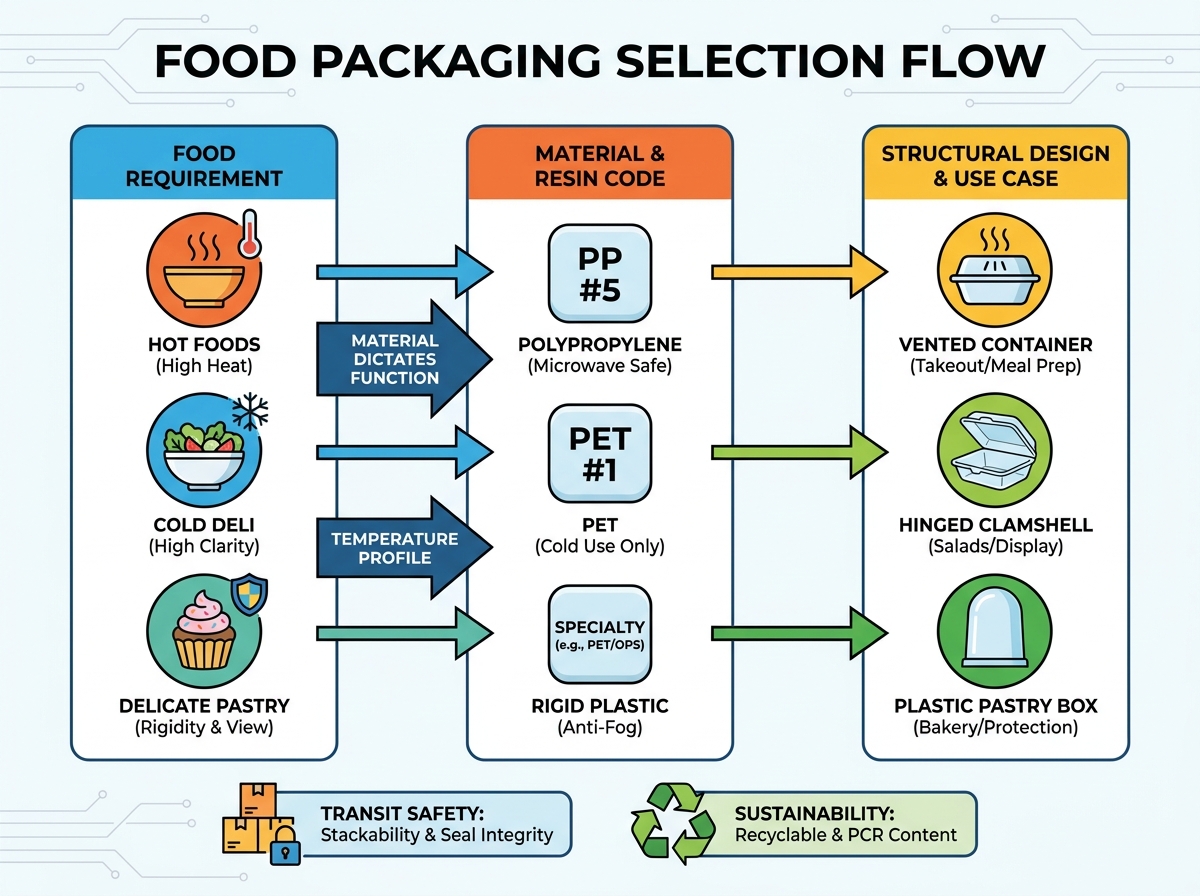
Material dictates function: PET offers superior clarity for cold items, while PP provides the heat resistance required for hot food delivery.
Structure impacts operations: Options range from open trays requiring secondary sealing to integrated clamshells built for rapid assembly.
Visual merchandising drives sales: Specialty containers, such as a dedicated Plastic Pastry Box, are engineered specifically to balance structural rigidity with 360-degree product visibility.
Compliance is non-negotiable: All selections must be evaluated against FDA/regulatory food-contact safety standards and operational temperature limits.
Operators must understand base resins deeply. The specific polymer dictates overall container performance. Material limits directly impact safety and presentation.
We rely on PET for high clarity and rigid structure. It provides an excellent moisture barrier. Municipalities recycle it highly effectively. However, it suffers from low heat tolerance. The material warps rapidly above 120°F (49°C). You cannot put it in a microwave safely. Use it primarily for cold deli items. It excels in salads and visual merchandising. Cold-chain logistics heavily favor PET. Supermarkets use it extensively to display fresh produce. It mimics the upscale appearance of glass closely.
PP brings vital high heat tolerance to your operations. It safely handles rigorous microwave reheating. The material naturally resists fats and aggressive oils. It proves highly durable during rough transit. PP usually appears translucent rather than perfectly clear. It feels slightly less rigid than PET. Use PP for hot food takeout. It perfectly supports meal prep containers and microwaveable meals. Chefs love PP for hot gravies and heavy sauces. It withstands boiling temperatures easily.
PS offers a highly rigid structure. Oriented polystyrene (OPS) provides excellent visual clarity. It remains highly cost-effective for tight budgets. However, PS acts incredibly brittle under mechanical pressure. It demonstrates poor heat resistance overall. Regulators increasingly ban it due to low recyclability. You might use it for short-term bakery displays. PET is rapidly replacing it everywhere. Many progressive operators refuse to stock PS today. It fractures too easily during assembly.
Comparison of Core Plastic Resins
Material | Visual Clarity | Heat Tolerance | Best Operational Use Case |
|---|---|---|---|
PET (#1) | High (Glass-like) | Low (Under 120°F) | Cold Deli, Salads, Merchandising |
PP (#5) | Medium (Translucent) | High (Microwave Safe) | Hot Takeout, Prepared Meals |
PS (#6) | High (OPS variation) | Low | Short-term Bakery (Phasing out) |
A PET hinged clamshell container features a permanently attached lid. This design dramatically streamlines inventory management. You only track one SKU instead of two. It heavily speeds up your packing lines. Employees grab, fill, and snap it shut rapidly. However, you must evaluate certain risks closely. Hinge durability and seal security often vary between manufacturers. You need reliable locking tabs. These mechanisms prevent disastrous transit spills. Cheap hinges snap during fast assembly. Robust hinges endure multiple opening cycles smoothly.
Two-piece designs allow for clever mixed materials. You might pair a heat-resistant PP base alongside a high-clarity PET lid. This strategy maximizes both thermal performance and visual appeal. Customers see the food clearly. The base safely holds hot items. The primary risk involves inventory bloat. You must manage two separate SKUs constantly. Lids and bases get separated easily. They also require significantly more back-of-house storage space. Mismatched lids cause severe operational bottlenecks.
You might select an open-top plastic food tray for streamlined processing. These require an automated film seal. Sometimes they use a separate drop-on lid. They prove excellent for high-volume automated sealing lines. We often see them protecting frozen foods. They also perfectly support MAP (Modified Atmosphere Packaging). MAP flushes oxygen out efficiently. It extends shelf life dramatically. Trays stack very tightly in warehouses. They minimize wasted cubic space.
Delicate baked goods need a dedicated Plastic Pastry Box. Manufacturers purpose-build these enclosures for fragile items. They prioritize maximum structural rigidity. This engineering explicitly prevents accidental crushing during display. They also integrate vital anti-fog properties. This treatment keeps refrigerated display cases looking pristine and appetizing. Condensation ruins delicate frosting. An anti-fog coating prevents moisture buildup completely. It maintains 360-degree product visibility perfectly.
Regulatory compliance remains entirely non-negotiable in food service. You must strictly verify supplier claims regarding food-contact compliance. We rely heavily on established frameworks like FDA Title 21 CFR standards. Never assume a newly sourced plastic is food-safe. Always demand written certifications from your manufacturing partners. Health inspectors will check these documents thoroughly.
Consumer skepticism around chemical safety runs high today. You must actively address these valid concerns. Start by confirming a baseline requirement for BPA-free materials across your supply chain. Always clarify the safe operating temperature ranges for your chosen plastics. Mistakenly heating PET causes immediate warping and potential chemical migration. Educate your kitchen staff regarding these strict thermal limits.
Sustainability goals often conflict against rigid operational realities. Industry trends show a massive shift toward rPET (recycled PET). You must assess the trade-off carefully. Balance sustainability mandates against your local recycling infrastructure capabilities. Sometimes post-consumer recycled (PCR) content slightly reduces packaging clarity. Test these materials before ordering bulk shipments. Consumers demand eco-friendly options constantly. However, they still expect flawless food protection.
Common Mistakes in Food Safety Compliance:
Relying on verbal safety assurances from unverified overseas suppliers.
Microwaving PET containers during busy lunch rushes.
Ignoring local municipal bans on specific resin codes.
Storing packaging near strong cleaning chemicals.
Stackability directly dictates structural integrity. You must observe how the container behaves under heavy vertical load. This remains crucial for tight back-of-house storage. It also impacts multi-item delivery orders significantly. Weak container walls lead to crushed food. Delivery drivers frequently stack multiple orders together roughly. Your packaging must survive this predictable abuse.
Seal integrity controls leak resistance completely. Evaluate the perimeter seal design closely. Compare simple button locks against continuous bar locks. Assess the specific risk of liquid leakage. Third-party delivery scenarios expose packaging to aggressive handling. A secure seal protects your hard-earned brand reputation. Spilled soup ruins the entire customer experience instantly.
You must balance ventilation against moisture retention carefully. Hot and crispy items desperately need vented containers. Trapped steam causes immediate sogginess. Fried foods lose their texture in mere minutes. Conversely, you need an airtight seal for baked goods. When you ship a specialized plastic food tray holding delicate items, moisture control prevents rapid staling. Sushi rice dries out quickly without a tight seal.
Transit Stress Test Framework:
Fill containers using boiling water to test thermal deformation.
Drop sealed containers from table height to evaluate latch security.
Stack five filled containers to measure downward flexural strength.
Simulate delivery vibration by driving containers across bumpy roads.
Procurement demands strict attention regarding volume and storage constraints. Rigid plastic packaging ships fully formed. It contains a lot of empty air. You must assess warehouse footprint constraints carefully. Do this before ordering high MOQs (Minimum Order Quantities). Pallets consume expensive square footage rapidly. Ensure you have adequate sanitary shelving available.
Decide strategically between custom tooling and off-the-shelf options. Standard molds provide lower unit costs. They guarantee significantly faster lead times. Custom tooling allows for embossed brand logos. It achieves highly specific dimensional requirements. However, custom molds require substantial upfront capital. They also delay initial production runs by several weeks.
Unit economics dictate your final choice. Calculate the true cost per package accurately. Include expected product loss rates in your math. Defective seals waste money constantly. Cracked hinges during assembly destroy profit margins. Every broken container eats directly into your restaurant's bottom line. Track these failure rates obsessively during your trial phase.
Best Practices for Supplier Shortlisting:
Audit warehouse shelving capacity thoroughly before confirming any MOQs.
Request comprehensive technical spec sheets verifying FDA compliance.
Measure actual assembly time in seconds per unit.
Calculate anticipated scrap rates resulting from brittle plastics.
Align your packaging choice directly against the food’s specific thermal profile.
Map the container design smoothly to your operational assembly workflow.
Prioritize the end-user's actual unboxing experience above minor unit cost savings.
Request physical samples from your shortlisted suppliers immediately.
Run aggressive in-house stress tests covering heat, freezing, stacking, and transit conditions before committing to a bulk order.
A: No. PET typically deforms at temperatures above 120°F. For hot foods, PP (Polypropylene) is required.
A: While both offer clarity, OPS (Oriented Polystyrene) is more brittle and prone to cracking under pressure. PET is more resilient and more widely accepted by municipal recycling programs.
A: No. Microwave safety depends entirely on the resin code. PP (#5) and specific CPET (Crystallized PET) trays are microwave safe, whereas standard PET (#1) and PS (#6) will melt or leach chemicals.
A: Select packaging treated with an anti-fog coating, or ensure hot foods are properly vented or cooled before sealing to maintain visual clarity.


