
Views: 0 Author: Site Editor Publish Time: 2026-06-27 Origin: Site


Selecting the right packaging goes far beyond simple aesthetics. It serves as a vital operational choice. This single decision shapes how consumers perceive your brand on retail shelves. It also dictates product shelf-life and directly drives profit margins. Bakery owners and procurement managers face a constant tug-of-war every single day. You must expertly balance visual appeal against rigid food-safety compliance. You also need to evaluate daily structural limits and strict per-unit budgets. Misjudging this delicate balance leads to crushed tiered cakes and stale cookies. Every bakery operation depends on precise material choices to protect delicate goods. The packaging you choose acts as a primary touchpoint for your buyers. This guide breaks down standard paper substrates alongside modern polymer alternatives. We will help you build a clear framework. You can accurately match specific menu items to the perfect packaging solution. By understanding exactly what goes into your boxes, you optimize freshness.
**Material Diversity:** Commercial bakery packaging primarily utilizes Solid Bleached Sulfate (SBS) paperboard, Kraft paper, corrugated board, and structurally clear polymers (PET).
**Visibility vs. Breathability:** A plastic pastry box offers superior visual merchandising and moisture retention, whereas paper options provide better ventilation for crusty baked goods.
**Compliance is Mandatory:** Regardless of substrate, all materials—especially food-grade plastic bakery boxes and coated papers—must meet strict FDA guidelines for direct food contact and grease resistance.
**Hidden Costs:** Misaligning the bakery box material with the product type leads to structural failure (crushing), grease bleed-through, or premature staling, directly impacting the bottom line.
You must evaluate your bakery box material carefully before purchasing. Different substrates serve entirely different operational purposes. The industry relies heavily on three specific paper-based options. Understanding their distinct physical properties prevents costly procurement errors.
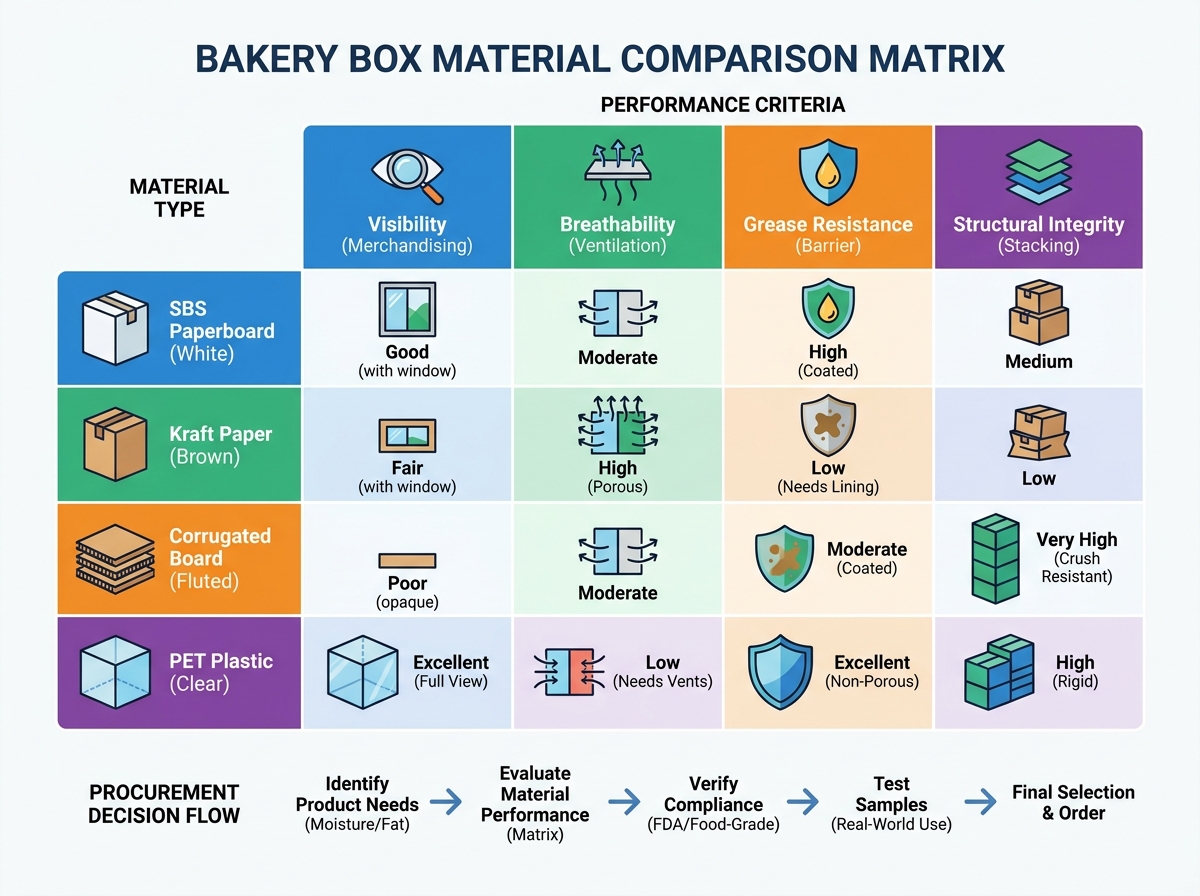
Solid Bleached Sulfate (SBS) paperboard remains the dominant choice. Bakers use it daily for standard cake boxes and pie boxes. SBS offers excellent printability. This makes it ideal for complex branding and vibrant logos. However, SBS has distinct physical limitations. The raw board absorbs oils rapidly. It requires a polyethylene (PE) coating. This thin plastic lining prevents grease absorption. Without it, butter-heavy items will ruin the box exterior in hours.
Unbleached Kraft paper appeals strongly to artisanal brands. You often see it used for rustic or organic bakery items. Consumers perceive Kraft paper as highly eco-friendly. Yet, Kraft is inherently porous. This material demands specialized natural or synthetic linings. These linings maintain structural integrity. They prevent the box from degrading when holding greasy pastries.
Corrugated board utilizes a durable micro-flute structure. Procurement teams source this specifically for heavy tiered cakes. It also works perfectly for bulk catering transport. Corrugated board provides unmatched crush resistance. It also delivers excellent thermal insulation during transit. The downside involves higher costs per unit. Corrugated boxes also require significantly more back-of-house storage space.
Material Substrate | Primary Bakery Application | Inherent Breathability | Moisture Retention |
|---|---|---|---|
Solid Bleached Sulfate (SBS) | Standard cakes, fruit pies | Moderate | Low (Requires PE layer) |
Unbleached Kraft Paper | Artisanal breads, rustic pastries | High | Very Low |
Corrugated Board (Micro-flute) | Heavy catering orders, tiered cakes | Moderate | Moderate |
Polyethylene Terephthalate (PET) | Retail visual display, macarons | Zero (Requires physical vents) | Maximum |
Retail environments demand aggressive visual merchandising. A fully transparent Plastic Pastry Box drives immediate impulse purchases. Customers see the vibrant colors of your baked goods instantly. They do not need to open the packaging. This maximizes product visibility. It directly increases front-of-house conversion rates and overall sales volumes.
Polyethylene Terephthalate (PET) dominates this specific category. The industry considers PET the absolute standard for rigid packaging. It delivers unmatched optical clarity and structural strength. PET also provides high shatter resistance during handling. However, implementation carries specific operational risks. You must manage the risk of condensation carefully. Warm muffins or freshly baked rolls release steam. You must specify vented boxes for these items. Vents allow steam to escape naturally. This prevents soggy textures and maintains crust integrity.
Beyond visibility, polymers excel at moisture control. A high-quality PET pastry box creates an absolute barrier against ambient humidity. Many delicate treats degrade quickly in humid environments. Macarons and iced sugar cookies absorb moisture from the air rapidly. Plastic prolongs the shelf-life of these moisture-sensitive items. It outperforms standard paperboard significantly in humid climates. Your inventory stays fresher, extending your profitable selling window.
Safety regulations dictate exactly what touches your food. You must understand direct food contact standards. Not all polymers qualify as safe for consumption. Truly compliant packaging requires virgin materials. Alternatively, it uses strictly regulated recycled content. These certified materials prevent chemical leaching into your products. High-fat or highly acidic baked goods accelerate chemical migration.
You must verify supplier credentials before ordering. Instruct your procurement buyers to demand compliance documentation. They should request FDA Title 21 CFR certificates. Local regulatory equivalents work well for international operations. Always secure these documents before ordering bulk food-grade plastic bakery boxes. This protects your customers and shields your business from severe legal liability.
Common mistakes involve misunderstanding paper alternatives. Many buyers assume paper boxes contain zero plastic. This reflects a false coating reality. Even premium paper boxes rely heavily on plastics. They use PE or aqueous linings. Suppliers apply these to window panels and interior base boards. These barriers prevent oil migration. Buyers must understand they often purchase hybrid materials. Knowing this ensures accurate compliance tracking across your entire inventory network.
Choosing the right packaging requires rigorous physical testing. You should follow a structured evaluation framework. Do not rely entirely on supplier specifications. Real-world bakery environments stress materials differently.
First, assess structural integrity and stacking limits. You must evaluate crush resistance under real-world conditions. How many units can sit stacked during transit? You need to know exactly when the bottom box fails.
Here are the critical steps for testing transit performance:
Assemble five identical test boxes.
Fill them using your heaviest menu items.
Stack them inside your standard delivery crates.
Simulate a delivery route by driving them for 30 minutes.
Measure any deflection or crushing on the bottom tier.
Next, establish a grease and moisture resistance rating. Paper substrates soften significantly when exposed to butter. Advise your buyers to test materials against their highest-fat items. Place croissants or buttercream cakes inside the samples. Leave them at room temperature for 24 to 48 hours. Evaluate the exterior for bleed-through. Check the interior base for structural softening.
Finally, evaluate operational scalability. Packaging impacts your labor budget daily. Compare the assembly time of different formats. Flat-packed auto-popup paper boxes require manual folding. Rigid, pre-formed plastic containers require zero assembly. Time your staff assembling fifty units of each. Factor these direct labor costs into the per-unit price. A slightly more expensive rigid container often saves hundreds of labor hours annually.
The packaging industry faces intense environmental scrutiny. Many operators promote paper as the ultimate green choice. However, the grease contamination issue complicates this narrative. You must understand how municipal recycling facilities actually operate. Heavily grease-stained paperboard cannot be recycled easily. Butter and oils ruin the paper pulping process completely. Furthermore, paper featuring thick PE linings usually faces strict rejection. Facilities divert these contaminated boxes straight to landfills.
Plastics face their own environmental pushback. Yet, we must look at polymer recyclability objectively. Clean PET pastry box containers are highly recyclable. They belong to standard municipal streams under Code 1. Waste facilities process rigid clear plastics very efficiently. A clean polymer container is often more recyclable than a grease-soaked paper box.
Your sourcing strategy requires a balanced approach. Guide your decision-makers to prioritize right-sizing your packaging. Reduce the overall material volume per pastry. Smaller boxes mean less waste regardless of the chosen substrate. Do not rely solely on green marketing buzzwords. Evaluate the entire product lifecycle when making bulk procurement choices.
The choice between paperboard and plastic hinges entirely on your specific product needs. Prioritize breathability for crusty breads and moisture retention for delicate macarons.
Your primary sales environment dictates your ideal material. Choose rigid corrugated boards for wholesale transport and highly transparent polymers for retail display.
Audit your current packaging failure rates immediately. Track incidents of premature staling or delivery crushing to identify your actual operational bottlenecks.
Request physical sample kits from multiple suppliers. Perform 48-hour grease tests using your heaviest buttercream items before committing funds.
Always secure FDA Title 21 CFR compliance certificates. Verify these critical documents before agreeing to any bulk minimum order quantities (MOQs).
A: Yes, but you must use specialized vented versions. Warm goods release steam, causing heavy condensation inside airtight polymers. This moisture drips back onto the product, ruining crusts and textures. You should always implement strict cooling protocols prior to packaging to minimize steam buildup.
A: Usually, they are different. Paper box windows typically utilize very thin acetate or flexible PET films designed purely for visibility. Rigid plastic pastry containers use structural, high-gauge PET. The rigid version supports stacking weight and provides impact resistance, whereas thin window films offer zero structural support.
A: You can perform a rapid operational test in your kitchen. Smear a tablespoon of pure butter or colored baking oil directly onto the interior base of the sample box. Leave it at room temperature for 48 hours. If any dark spots or oil rings appear on the outside, it fails.
A: Standard PET has specific temperature tolerances. While excellent for refrigeration, standard PET can become brittle and shatter in deep-freeze environments. If you require blast-freezing, you must ask your supplier for freezer-grade formulations. Consider alternative materials designed specifically to withstand sub-zero expansion without cracking.


