
Views: 0 Author: Site Editor Publish Time: 2026-10-15 Origin: Site


Transporting fresh salads exposes containers to relentless vibrations, sudden stacking pressure, and unexpected inversion. Dressing leaks and compromised ingredient integrity run rampant during commercial transit if packaging fails. For meal prep services, catering operations, and restaurant delivery, these failures create serious friction. They trigger instant refund requests from unhappy diners. They spark negative reviews online and quietly destroy your customer lifetime value over time. Reliable packaging prevents this operational bleed. We will examine the critical structural lid features and sealing mechanisms you need to evaluate. You will learn exactly how a well-engineered lid dictates how securely a PET Salad Container performs during commercial transit. From audible perimeter seals to tamper-evident locks, we cover the essential physics of secure food transport.
Food transport demands strict success criteria. Packaging must maintain a reliable barrier against oxygen exchange. It must also prevent mechanical separation during standard delivery routes. When lids pop off in transit, the immediate spill is obvious. However, weak lids carry hidden costs. Inadequate closures lead to severe cross-contamination inside mixed delivery bags. If vinaigrette leaks onto a paper bag, it weakens the paper. This often causes the bag to tear, dropping the entire order onto the pavement. Poor seals also allow excess air exchange. This causes rapid oxidation of leafy greens, ruining texture and taste before the customer takes their first bite.
Comparing the fractional cost of premium lids against operational losses highlights a clear return on investment. A slight price increase for tightly toleranced lids saves dollars in wasted ingredients. You avoid paying drivers for a second delivery trip. You also rescue your brand reputation from frustrated customers. Remaking a complex salad during a Friday dinner rush disrupts kitchen flow. Securing a reliable lid eliminates this operational friction entirely. You protect your margins and ensure a consistent dining experience.
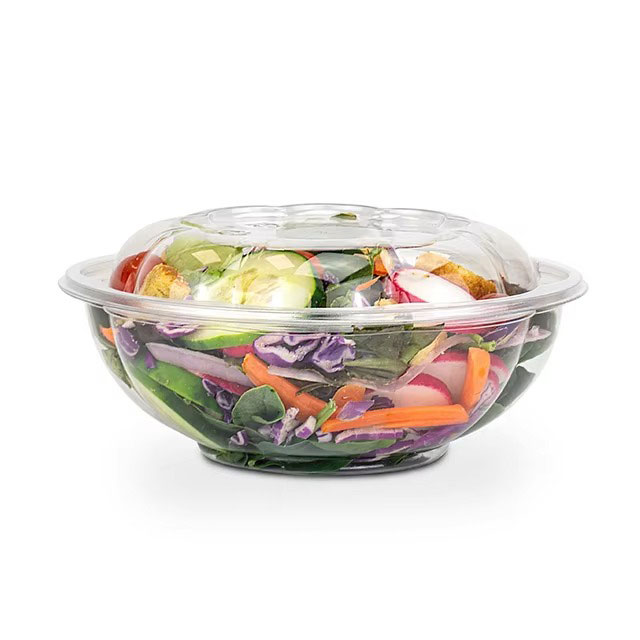
Kitchen staff move extremely quickly during peak service hours. They cannot afford to double-check every single package. They rely heavily on tactile and acoustic feedback to verify closures. Audible snap-closure systems provide a distinct "click". This confirms a secure 360-degree perimeter seal before the container ever enters the delivery bag. If a lid closes silently, staff may miss an unsealed corner.
The geometry of the flange and groove completely determines leak resistance. A tight inner channel must hug the rolled brim of the container base perfectly. Manufacturers engineer this interlocking fit to prevent micro-leaks. This tight tolerance becomes critical when you use low-viscosity dressings. If the gap between the lid groove and the base brim exceeds standard manufacturing tolerances, liquid easily escapes during transit vibrations.
Anti-fog coatings often seem like a purely aesthetic feature. However, they play a highly practical transit role. Clear visibility eliminates the need for delivery drivers or customers to squeeze or open the container. They can visually verify the contents instantly. Preserving the factory seal ensures the pet salad container remains fully protected throughout its journey. Foggy lids tempt people to peel back the corner, which ruins the secure transit seal.
Bulk delivery and catering operations involve stacking multiple orders. Recessed nesting channels are engineered specifically for this high-volume scenario. Flat lids featuring raised outer rims allow multiple containers to stack securely. They physically lock the base of the upper unit directly into the lid of the lower unit. This prevents sliding during sharp vehicle cornering or sudden braking.
Domed lids operate on entirely different physics. They protect high-volume, delicate ingredients like microgreens and croutons from bruising. However, domed structures naturally attract top-load pressure to their center point. They require thicker gauge PET at the apex. This added material thickness prevents the dome from crushing inward under heavy weight.
Proper base-to-lid weight distribution remains critical for transit survival. A well-designed lid transfers downward force outward and directly into the strong vertical sidewalls of the base. It prevents force from concentrating on the vulnerable closure seam. If pressure hits the closure seam directly, the container inevitably pops open.
Different business models demand distinct lid architectures. Selecting the wrong style causes transit failures and poor merchandising displays. Let's look closely at varying pet salad container applications to understand optimal matching.
Retail Grab-and-Go sectors require high-clarity domed lids. These lids showcase ingredient volume and vibrant colors beautifully. They prioritize aesthetic appeal on the brightly lit retail shelf. They also maintain excellent shelf-stacking stability for retail display coolers, enticing walk-by consumers.
Meal Prep Services need flat, highly uniform lids above all else. Space efficiency is paramount for subscription models. Flat lids maximize vertical space inside standard corrugated shipping boxes. They fit snugly alongside gel ice packs. They also stack cleanly inside consumer refrigerators, ensuring space optimization for weekly meal plans.
Third-Party Delivery demands highly secure, exceptionally tight-fitting closures. These containers endure rapid handling, bumpy roads, and unstable transport environments. Bicycle couriers often tilt bags dramatically inside their backpacks. The lid must survive these harsh angles without yielding or leaking dressing.
Application vs. Lid Geometry Comparison
| Business Application | Preferred Lid Style | Primary Benefit | Transit Risk Factor |
|---|---|---|---|
| Retail Grab-and-Go | Domed | Maximum ingredient visibility and volume display | Crushing under excessive top-load weight |
| Meal Prep Services | Recessed Flat | Optimizes shipping box and fridge space | Ingredient compression if overfilled |
| Third-Party Delivery | Tamper-Evident Flat | Prevents leaks during tilted backpack transport | Staff failing to engage the locking band fully |
Delivery platforms introduce serious chain-of-custody risks. Customers worry about driver interference. Tamper-evident (TE) features solve this fundamental trust gap. Tear-away hinge bands physically break upon the very first opening. They visually verify the food remained secure between your kitchen and the end consumer. This builds immense brand loyalty.
Brands often want unique packaging to stand out. Designing a custom pet salad container with embossed lids creates strong brand recall. However, custom logos or physical patterns can unintentionally create weak points in the plastic matrix. You must ensure deep embossing does not compromise the lid's structural integrity. Poorly engineered embossing drastically reduces crush resistance during transit.
If integrated TE bands exceed your current packaging budget, evaluate label-ready smooth surfaces. Lid designs must feature dedicated, perfectly flat real estate. This allows tamper-evident branded stickers to adhere firmly. The surface must be smooth enough so stickers do not wrinkle or peel off in humid, refrigerated environments.
Avoid heavily textured lids if you plan to use adhesive tamper labels. Adhesives fail quickly on grooved or frosted PET surfaces. Always request smooth panels for label placement.
Never buy packaging blindly based on catalog photos. You must execute rigorous real-world stress testing before bulk procurement. Practical testing frameworks save you from catastrophic transit failures later. Testing validates manufacturer claims.
Conduct the inversion and drop test on any shortlisted container. Fill the base with water. Seal the lid firmly, ensuring you hear the snap. Invert it completely for 10 minutes. If no water escapes, perform a 3-foot drop test onto a hard surface. This simulates an accidental drop by a rushing delivery driver. The lid should remain attached, even if the base cracks.
Recognize the strict temperature limitations of PET plastic. This is a transparent assumption we must state clearly. PET material works strictly for cold or ambient foods. Exposing these lids to hot proteins, warm dressings, or freshly cooked grains causes immediate warping. The interlocking seal will fail instantly, rendering the transit protection useless.
Vendor tolerance consistency poses a major operational risk. Batch variance ruins kitchens. A tight lid in sample A must perform identically in a massive pallet order. You require a supplier who maintains strict manufacturing tolerances across million-unit runs. Minor millimeter variations cause massive leakage spikes.
Secure transit relies heavily on precise perimeter seal geometry. It depends on robust stacking mechanisms and matching the correct lid style to your specific business application. Domed lids serve retail display brilliantly, while flat recessed lids dominate shipping logistics.
When sourcing packaging, prioritize vendors who eagerly provide physical samples. Base your final procurement decisions entirely on in-house drop and inversion tests. Always use your exact menu items during these tests to gauge real-world performance accurately.
A: No. High-quality snap-fit lids with precision flanges are designed to be mechanically leak-resistant for standard transport without secondary heat seals, though they are not fully hermetic.
A: No. PET plastic generally distorts at temperatures above 120°F (49°C). Hot dressings will compromise the lid's seal and cause immediate leakage.
A: They require slightly more initial downward force to engage the locking band, but a well-designed TE lid should still snap shut in a single, fluid motion without slowing down the prep line.
A: A recessed lid features a dropped center panel that creates a physical barrier, locking the base of the container above it in place to prevent sliding during transit.


