
Views: 0 Author: Site Editor Publish Time: 2026-10-12 Origin: Site


A subpar container leads directly to leaked dressing, wilted greens, and refunded delivery orders. These daily operational failures impact your profit margins. They also damage your hard-earned brand reputation. Restaurant owners must shift their evaluation criteria immediately. You cannot look at simple unit cost alone. You must evaluate the total operational value of your packaging. Procurement decisions require balancing food presentation, physical durability, and daily kitchen workflow. Finding the right vessel is no longer just a mundane purchasing task. It serves as a critical pillar of your overall customer experience. This article outlines the essential criteria procurement teams must use. You will learn how to vet suppliers effectively and align packaging materials with your menu. We will also explore strategies to optimize storage space and protect off-premise orders from kitchen to customer.
Selecting the right resin type is the foundational step in packaging procurement. You cannot use a one-size-fits-all approach for food containers. Your menu ingredients directly dictate the required polymer. Heat levels, storage conditions, and display methods all influence this choice.
PET stands out as the industry standard for cold, grab-and-go salads. It provides maximum optical clarity. Consumers buy food with their eyes. High clarity makes your fresh greens and colorful toppings look vibrant. PET also delivers excellent crack resistance. It survives accidental drops on the prep line. Furthermore, recycling facilities accept PET widely. However, you must respect its thermal limits. PET is highly vulnerable to heat. It will warp significantly at temperatures above 120°F. Never use PET if you serve warm grains or freshly grilled proteins.
Polypropylene is essential for menus featuring warm ingredients. If you serve grilled chicken, hot quinoa, or roasted vegetables, you need PP. This material boasts a high heat tolerance. It easily withstands hot food applications. Consumers can also place PP containers safely in the microwave. Visually, PP differs from PET. It usually appears opaque or semi-clear. It does not offer the glass-like transparency of PET. You trade some visual appeal for crucial thermal stability.
You must prioritize food safety above all other metrics. Always demand thorough documentation from your vendors. They must provide FDA-approved manufacturing certificates. Ensure all materials are certified BPA-free. Insist on strict food-grade manufacturing standards. Keep these compliance documents filed safely. Health inspectors may request them. Conscientious consumers also frequently ask about chemical leaching and material safety.
Many brands want to transition toward sustainable packaging. You must navigate this landscape carefully to avoid greenwashing. Two common alternatives are PLA (polylactic acid) and PCR (post-consumer recycled) plastics. PLA derives from renewable resources like corn starch. However, PLA requires commercial composting infrastructure to break down. If your local municipality lacks these facilities, PLA ends up in landfills. It acts just like traditional plastic there. Verify your local waste infrastructure before committing to PLA. PCR integrates recycled resin into new containers. It reduces virgin plastic consumption effectively.
Material Performance Comparison
| Material Type | Temperature Tolerance | Clarity Level | Best Use Case |
|---|---|---|---|
| PET | Cold (Below 120°F) | High / Glass-like | Refrigerated grab-and-go salads |
| PP | Hot & Cold (Microwave safe) | Semi-clear / Opaque | Salads with hot proteins or grains |
| PLA | Cold only | High | Eco-conscious cold menu items |
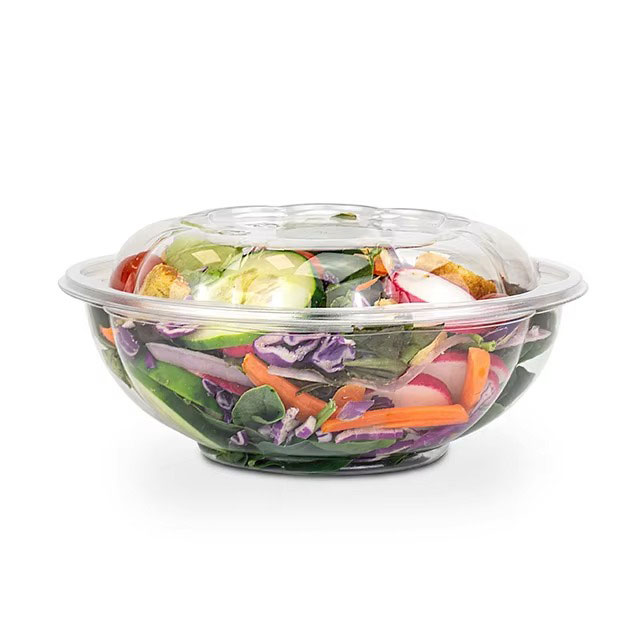
Your packaging must survive a rigorous journey. A bowl moves from the prep counter to a delivery bag. Drivers navigate bumpy roads. Finally, the customer unpacks it at home. Structural integrity guarantees the food arrives exactly as the chef intended.
Oil-based dressings pose the greatest threat to delivery orders. Oil penetrates weak seals much faster than water. You must strictly assess the lid-to-bowl closure mechanisms. Look for a tight snap-fit design. Secure perimeter seals are completely non-negotiable. A loose lid results in spilled vinaigrette. This ruins the structural integrity of the paper delivery bag. The bag tears, the food falls, and the customer demands a refund. Protect your margins by insisting on leak-proof standards.
Cold display cases present a unique environmental challenge. Temperature differentials cause condensation. Foggy lids obscure the food inside. Customers will not purchase a salad they cannot see. You must discuss anti-fog technology with your suppliers. Anti-fog lids are absolutely critical for high-volume plastic salad bowl applications in refrigerated displays. The chemical coating prevents water droplets from forming. It maintains a perfectly clear viewing window for impulse buyers.
Delivery aggregators often stack multiple heavy bags together. Your bowls must withstand this external pressure. Evaluate the sidewall strength closely. Look for strategic ribbing along the bowl exterior. These vertical ridges add significant structural support. A weak bowl collapses under pressure. Crushed greens look unappetizing. A collapsed bowl also pops the lid off, causing massive spills. Invest in rigid sidewalls to protect the food architecture.
Packaging impacts your kitchen staff directly. Poor container design slows down prep times and frustrates employees. You must evaluate how the right plastic salad bowl integrates into your existing operational footprint.
Restaurant kitchens rarely have excess storage space. Shelf real estate commands a premium. You must analyze nesting capabilities carefully. Bowls should slide into each other tightly. Poorly stacking bowls create tall, unstable towers. They consume valuable dry storage space. Furthermore, loose nesting means you are paying to ship air. Inefficient stacking increases shipping freight costs dramatically. Tight nesting keeps freight expenses low and shelves organized.
Peak lunch hours test your kitchen workflow. Every second matters on the assembly line. Evaluate lid application speed during your trials. Lids must snap on quickly and intuitively. Some lids require employees to trace the entire perimeter carefully. This slow application process bottlenecks the prep line. Frustrated staff may also apply difficult lids incorrectly. An improperly sealed bowl leads to inevitable delivery leaks. Prioritize lids offering a swift, audible snap.
Managing multiple packaging SKUs causes administrative headaches. It also increases the risk of ordering errors. You should actively look for suppliers offering universal lid systems. You can streamline operations by following these consolidation steps:
This strategy reduces SKU counts significantly. It lowers your inventory complexity and prevents line stoppages caused by missing lids.
Generic packaging serves a functional purpose. However, customized packaging acts as a mobile billboard. You must weigh the upfront financial commitment against the long-term marketing benefits. Brand recognition drives repeat orders in a crowded marketplace.
Premium packaging elevates the perceived value of your food. Customers naturally associate sturdy, branded containers with high-quality ingredients. Embossed logos on the lid create a tactile experience. Custom-printed sidewalls reinforce your visual identity. By utilizing a custom plastic salad bowl, you position your brand above standard fast-food alternatives. This elevated perception allows you to command higher menu prices. Customers willingly pay a premium for a cohesive, upscale dining experience at home.
You must compare the direct costs of custom tooling and printing. Many operators use unbranded bowls paired with custom tamper-evident stickers. Stickers offer a lower barrier to entry. However, applying stickers requires ongoing manual labor. During a rush, staff may place stickers crookedly. Custom-printed bowls require zero extra labor on the prep line. Calculate your monthly labor spend on sticker application. Compare that figure against the unit cost increase of pre-printed bowls. This clarifies the true financial impact.
Custom packaging introduces new supply chain complexities. Manufacturers require extended lead times for printed items. You cannot rely on next-day generic delivery. You must also factor in higher Minimum Order Quantities (MOQs). Factories typically demand large volume commitments to run custom plates. Evaluate your cash flow and warehousing costs carefully. Storing hundreds of boxes requires capital and physical space. Ensure your sales volume justifies the custom inventory investment.
Never sign a purchase order based solely on digital catalogs. Images hide structural flaws. You must physically handle the products. Establishing a rigorous testing protocol protects your business from massive operational failures.
Request samples from at least three different vendors. Distribute these samples to your kitchen managers. Execute the following stress tests in a real kitchen environment:
Product quality means nothing if the vendor cannot deliver reliably. Assess your vendor closely. Understand the risks of domestic inventory versus overseas shipping. Overseas suppliers often offer lower unit costs. However, ocean freight introduces delays and port strikes. Domestic suppliers provide faster turnaround times. We strongly advise establishing secondary supplier redundancy. If your primary vendor faces a shortage, your secondary vendor keeps your kitchen running smoothly.
Choosing the correct container requires strategic thinking. You must align food science, operational workflow, and marketing presentation. Temperature dictates your material choice between PET and PP. Storage constraints dictate your nesting requirements. Brand ambition drives your customization decisions. Never treat packaging as an afterthought.
Start your optimization process today. Audit your current menu temperature profiles accurately. Calculate your realistic monthly order volumes. Contact three shortlisted vendors and request a mixed-material sample pack. Run the physical stress tests in your kitchen. By evaluating these factors methodically, you will protect your food quality, speed up your prep lines, and enhance your overall customer experience.
A: PET (Polyethylene Terephthalate) is the absolute best choice for cold salads. It provides exceptional glass-like clarity. This transparency makes ingredients look fresh and appetizing. PET also responds well to anti-fog coatings, keeping refrigerated display items perfectly visible to customers.
A: It depends strictly on the material. PP (Polypropylene) bowls are heat-resistant and microwave-safe. They handle hot ingredients perfectly. However, PET bowls are highly sensitive to heat. You should never microwave PET, as it will warp, melt, and potentially ruin the food.
A: Customization requires significant volume. Industry baselines typically range from 50,000 to 100,000 units per order. This depends on the specific printing methods or custom embossing required by the factory. You must secure adequate warehouse space before ordering.
A: Stackability and food volume dictate lid styles. Flat lids provide excellent nesting for delivery bags and tight storage spaces. Dome lids are necessary for high-volume leafy greens. Domes prevent delicate lettuce from getting crushed while maintaining visual appeal.


